Digital Tools for Planners in the Construction Industry
Digital technologies are fundamentally transforming architectural and construction practice by enabling planners to work with more efficient design processes, realistic simulations, and well-informed decision-making. Applications such as BIM, simulation software, and AI extend traditional methods into computer-based tools and, with the help of web-based platforms such as Ubakus, EnerCalc, or the Energy Efficiency Demonstrator, support the planning of energy-efficient and sustainable buildings.
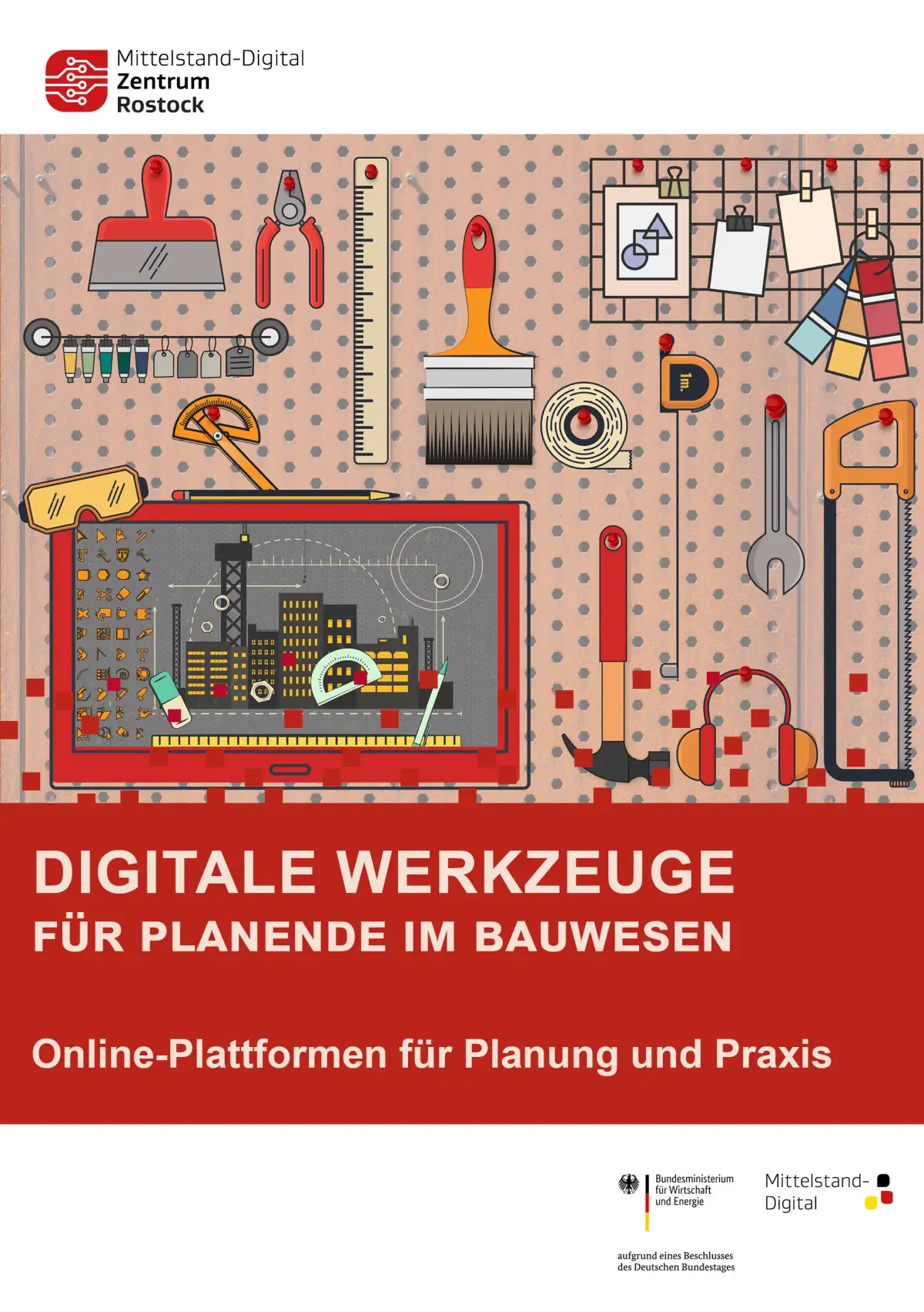
Hochschule Wismar, as a partner in the Mittelstand-Digital Center Rostock, has published a practice-oriented overview of digital tools. The publication is aimed at professionals and companies seeking to use digital technologies in a targeted manner to increase the efficiency, quality, and sustainability of construction projects. It describes the functions, application areas, and advantages of selected software, online tools, calculators, configurators, and databases, and complements them with practical examples from everyday planning practice.
The publication follows the entire planning process, beginning with an introduction to digital transformation and the selection of relevant categories. A systematic overview provides initial orientation on available tools and scales. In the subsequent chapters, digital applications are explained along specific thematic fields—ranging from site analysis and mobility to BIM-supported management, refurbishment, energy and building physics, as well as timber planning, cost estimation, and legal frameworks. A concluding outlook places the findings in context and highlights future development potential.
However, challenges remain: data security, unequal digital competencies, or excessive reliance on standardized results can hinder innovation. Standards and regulations such as DIN standards, building codes (BauO), QNG, or DGNB standards ensure transparency, interoperability, and collaborative workflows, enabling companies to fully exploit the potential of digitalization and actively contribute to sustainable, climate-neutral architecture.